Problem 1.15:
Solution:
Given:
\( V_{1} = 120\,\text{m/s} \),
\( T_{1} = 225^{\circ}\,\text{C} = 498\,\text{K} \),
\( p_{1} = 2.5\,\text{MPa} \),
\( V_{e} = 30\,\text{m/s} \),
\( T_{e} = 80^{\circ}\,\text{C} = 353\,\text{K} \),
\( p_{e} = 2.45\,\text{MPa} \).
To calculate: \( \dot{q}/\dot{m} = ? \), \( \rho_{1} = ? \), \( \rho_{e} = ? \).
The schematic diagram of the problem description is shown in Fig. 1.
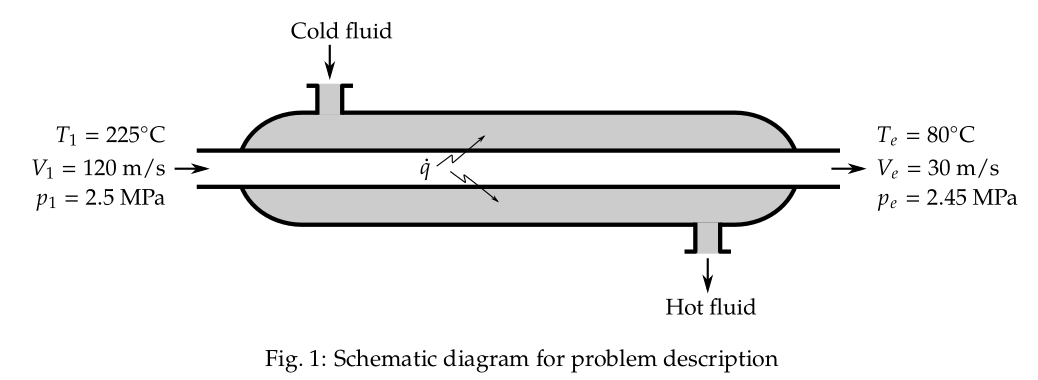
Applying the conservation of energy,
$$ \text{Rate of energy at inlet} + \text{Rate of heat addition} = \text{Rate of energy at exit} $$ $$ c_{p}T_{1}+\frac{V_{1}^{2}}{2}+\frac{\dot{q}}{\dot{m}}=c_{p}T_{e}+\frac{V_{e}^{2}}{2} $$Taking the heat capacity of air at constant pressure, \( c_{p}=1005\,\text{J/kg-K} \),
The negative sign indicates that the heat is removed. The heat removed per kilogram of air flowing through the heat exchanger,
--- Ad ---
---
The density at the inlet and exit can be calculated using the ideal gas equation.