Problem 1.13:
Solution:
Given:
Air is drawn vertically, \( \dot{m}=3\,\text{kg/s} \),
\( V_{1}\approx0\,\text{m/s} \),
\( p_{\text{amb}}=p_{0}=100\,\text{kPa} \),
\( T_{\text{amb}}=T_{0}=30^{\circ}\,\text{C}=303\,\text{K} \).
Air is compressed and heated and discharged horizontally,
\( V_{e}=500\,\text{m/s} \),
\( p_{e}=140\,\text{kPa} \),
\( \dot{q}=600\,\text{kW} \).
To calculate: \( A_{e}=? \), \( \text{Thrust}=? \).
The schematic diagram of the problem description is shown in Fig. 1.
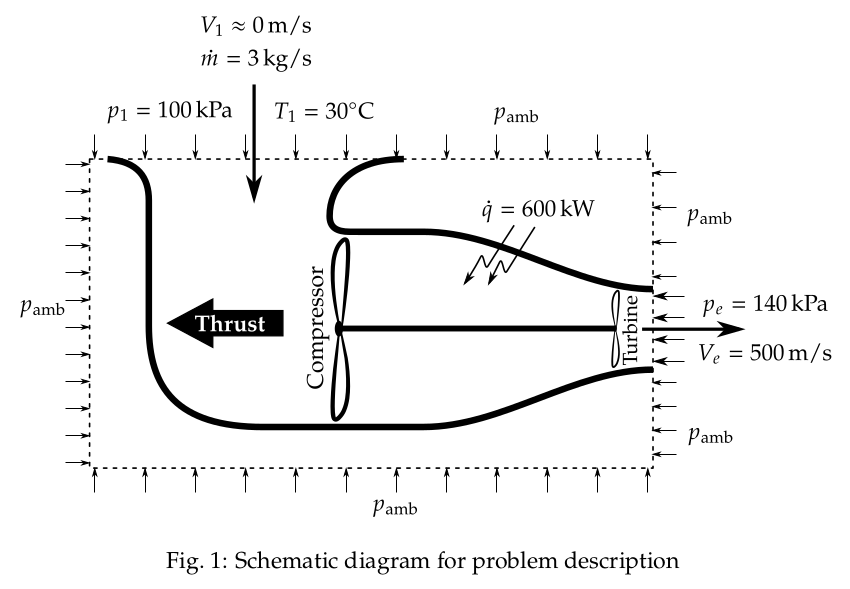
Applying the conservation of energy through the system,
$$ \begin{aligned} \text{Rate of energy entering}\ &+\ \text{Rate of heat addition} \\ &=\text{Rate of energy leaving}\ +\ \text{Work done by the system} \end{aligned} $$ $$ \dot{m}\,c_{p}T_{0}+\dot{q}=\dot{m}\,c_{p}T_{e}+\dot{m}\,\frac{V_{e}^{2}}{2}+W $$--- Ad ---
---
The density at the exit can be calculated using the ideal gas equation,
Applying the conservation of mass equation,
Applying the conservation of horizontal momentum,
$$ \text{Thrust}=\dot{m}_{e}V_{e}+\left(p_{e}-p_{\text{amb}}\right)A_{e} $$