Problem 1.1:
An air stream enters a variable area channel at a velocity of
m/s with a pressure of
kPa and a temperature of
oC. At a certain point in the channel, the
velocity is
found to be m/s. Using Bernoulli's equation
(i.e. \( p + \rho V^2/2 = constant \)), which assumes incompressible flow, find the pressure at this point.
In this calculation, use the density evaluated at the inlet conditions. If the temperature of the air is
assumed to remain constant, evaluate the air density at the point in the flow where the velocity is
250m/s.
Compare this density with the density at the inlet to the channel. Based on this comparison, do you think
that the use of Bernoulli's equation is justified?
Solution:
The problem description is schematically shown in Fig. 1.
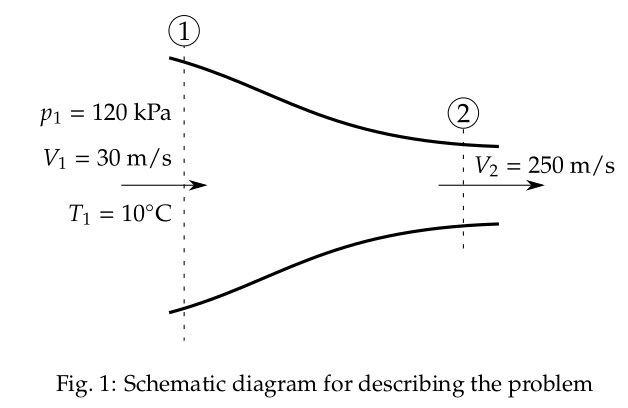
Since the flow is assumed to be incompressible, \( \rho \) is constant and can be calculated at station 1 using ideal gas equation,
Using the Bernoulli's equation
$$
p_{1}+\rho\,\frac{V_{1}^{2}}{2}=p_{2}+\rho\,\frac{V_{2}^{2}}{2}
$$
which can be used to solve for pressure at station 2
$$
p_{2}=p_{1}+\frac{\rho}{2}\left(V_{1}^{2}-V_{2}^{2}\right) \qquad\leftarrow (eq.1)
$$
Substituting in (eq.1), the pressure at station 2 can be calculated as, $$ p_{2}=p_{1}+\frac{\rho}{2}\left(V_{1}^{2}-V_{2}^{2}\right) $$
If the temperature of the air is assumed to remain constant,
,
then we can calculate the density at station
2 to be,
The percentage difference in calculated density, at station
1 and assuming constant temperature is,
$$
\%\ \text{difference in density calculation} =
\frac{\rho_{1}-\left.\rho\right|_{T=\text{constant}}}{\left.\rho\right|_{\text{Bernoulli}}}\times100
$$
Since the flow is assumed to be incompressible, \( \rho \) is constant and can be calculated at station 1 using ideal gas equation,
--- Ad ---
---
Substituting in (eq.1), the pressure at station 2 can be calculated as, $$ p_{2}=p_{1}+\frac{\rho}{2}\left(V_{1}^{2}-V_{2}^{2}\right) $$