Problem 2.7:
Solution:
Given: adiabatic air flow\( \implies dq=0 \),
\( A =\) 0.1 m2,
\( p= \) 120 kPa,
\( T= \) 15oC = 288 K,
\( dA/dx= \) 0.1 m2/m.
To plot: \( dp/dx, dV/dx \) and \( d\rho/dx \) for velocity between \( V= \) 50 m/s and 300 m/s.
--- Ad ---
---
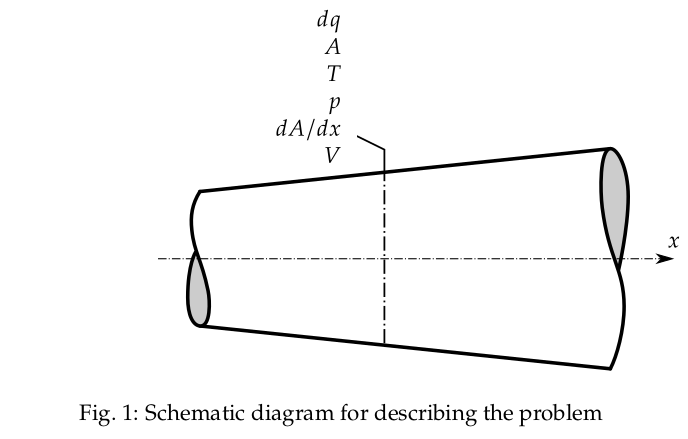
The schematic diagram of the problem description is shown in Fig. 1.
The differential form of mass equation can be written as,
\[ \frac{1}{\rho}\,\frac{d\rho}{dx}+\frac{1}{A}\,\frac{dA}{dx}+\frac{1}{V}\,\frac{dV}{dx}=0 \] \begin{equation} \frac{1}{\rho}\,\frac{d\rho}{dx}+\frac{1}{V}\,\frac{dV}{dx}=-\frac{1}{A}\,\frac{dA}{dx}\label{eq:mass-eqn} \end{equation}--- Ad ---
---
The differential form of momentum equation (Euler equation) along horizontal direction gives,
\begin{equation} \frac{1}{\rho}\,\frac{dp}{dx}+V\,\frac{dV}{dx}=0\label{eq:momentum-eqn} \end{equation}The differential form of the energy equation (for adiabatic flow) can be written as,
\begin{equation} c_{p}\frac{dT}{dx}+V\,\frac{dV}{dx}=0\label{eq:energy-eqn} \end{equation}Differentiating the equation of state for ideal gas with respect to \( x \) gives,
\begin{equation} \frac{1}{p}\,\frac{dp}{dx}-\frac{1}{\rho}\,\frac{d\rho}{dx}-\frac{1}{T}\,\frac{dT}{dx}=0\label{eq:eos} \end{equation}--- Ad ---
---
Writing the above equations (\ref{eq:mass-eqn}), (\ref{eq:momentum-eqn}), (\ref{eq:energy-eqn}) and (\ref{eq:eos}) in a matrix form we obtain,
\[ \left[\begin{array}{cccc} 0 & 1/V & 1/\rho & 0\\ 1/\rho & V & 0 & 0\\ 0 & V & 0 & c_{p}\\ 1/p & 0 & -1/\rho & -1/T \end{array}\right]\left[\begin{array}{c} dp/dx\\ dV/dx\\ d\rho/dx\\ dT/dx \end{array}\right]=\left[\begin{array}{c} -\left(1/A\right)\times\left(dA/dx\right)\\ 0\\ 0\\ 0 \end{array}\right] \]These system of equations can be solved to obtain \( dp/dx \), \( dV/dx \), \( d\rho/dx \) and \( dT/dx \) for any given \( V \). The solution plots for velocity in the range [50, 300] m/s are drawn in Fig. 2, Fig. 3 and Fig. 4.