Problem 2.6:
Solution:
Given:
isothermal air flow \( \implies dT/dx=0 \),
\( V = \) 200 m/s,
\( T = \) 25oC = 298 K,
\( p = \) 120 kPa,
\( dV/dx = \) -0.3 \( V \).
To calculate: \( dp/dx \), \( ds/dx \), \( d\rho/dx \).
--- Ad ---
---
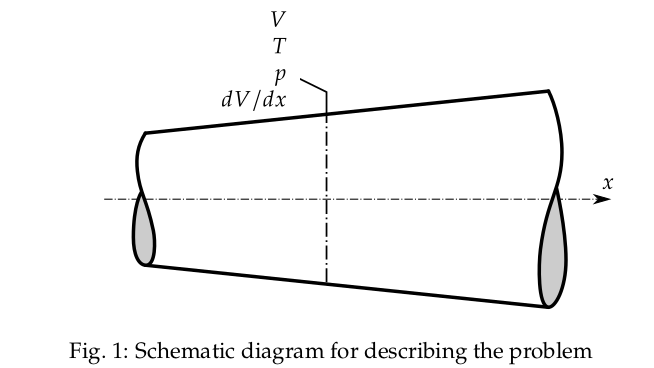
The schematic diagram of the problem description is shown in Fig. 1.
The density at the section can be calculated using the equation of state for an ideal gas as,
--- Ad ---
---
Using the conservation of momentum (Euler equation) in the horizontal direction, we get,
\[ \frac{1}{\rho}\frac{dp}{dx}+V\,\frac{dV}{dx}=0 \]which can be solved for pressure gradient as,
\[ \frac{dp}{dx}=-\rho\,V\,\frac{dV}{dx} \]Substituting the know gradient of velocity, we get,
--- Ad ---
---
Using the conservation of energy equation in its differential form, we get,
\[ c_{p}\cancelto{\text{isothermal flow}}{\frac{dT}{dx}}+V\,\frac{dV}{dx}-\frac{dq}{dx}=0 \]Using the definition of change in entropy,
--- Ad ---
---
Differentiating the equation of state for an ideal gas,
\[ \frac{1}{p}\frac{dp}{dx}-\frac{1}{\rho}\frac{d\rho}{dx}-\frac{1}{T}\cancelto{\text{isothermal flow}}{\frac{dT}{dx}}=0 \] \[ \frac{d\rho}{dx}=\frac{\rho}{p}\frac{dp}{dx} \]