At a section of a circular duct through which air is flowing the pressure is
o C,
the velocity is
Given: circular duct, 150 kPa, 35 o C = 308 K, 250 m/s, 0.2 m, 0.1 m/m
To calculate: \( dp/dx, dV/dx, d\rho/dx \).
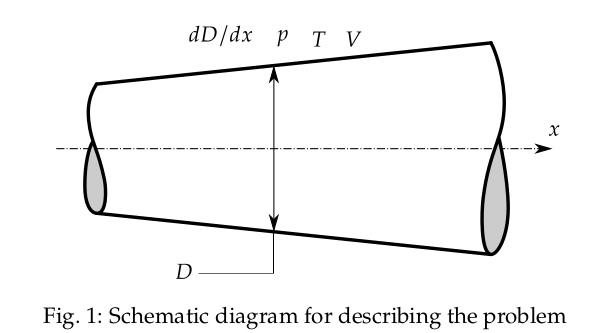
The schematic diagram of the problem description is shown in Fig. 1.
The cross-sectional area is circular thus,
\[
A=\frac{\pi}{4}D^{2}\ .
\]
Differentiating with respect to \( x \) gives,
\[
\frac{dA}{dx}=\frac{\pi D}{2}\,\frac{dD}{dx}\ .
\]
1
The density at the section can be calculated using the equation of state for ideal gas as,
\[
\rho=\frac{p}{R\,T}=\frac{150\times10^{3}}{287\times308}= 1.69691\, \text{kg/m}^3\ .
\]
Using the conservation of mass,
\[
\rho\,A\,V=\text{constant}\ .
\]
Differentiating the above equation with respect to \( x \) and diving by \( \left(\rho\,A\,V\right) \)
results in,
\[
\frac{1}{\rho}\,\frac{d\rho}{dx}+\frac{1}{A}\,\frac{dA}{dx}+\frac{1}{V}\,\frac{dV}{dx}=0\ .
\]
Substituting 1 we get,
\[
\frac{1}{\rho}\,\frac{d\rho}{dx}+\frac{\pi D}{2A}\,\frac{dD}{dx}+\frac{1}{V}\,\frac{dV}{dx}=0
\]
\[
\frac{1}{\rho}\,\frac{d\rho}{dx}+\frac{1}{V}\,\frac{dV}{dx}=-\frac{2}{D}\,\frac{dD}{dx}\ .
\]
2
The momentum equation along the duct in the differential form can be written as,
\[
\frac{1}{\rho}\frac{dp}{dx}+V\,\frac{dV}{dx}=0
\]
3
The energy equation along the duct in the differential form can be written as,
\[
c_{p}\,\frac{dT}{dx}+V\,\frac{dV}{dx}=0
\]
4
The equation of state for ideal gas is given by,
\[
p=\rho\,R\,T\ .
\]
Differentiating the equation with respect to \( x \) and dividing by \( \rho\,R\,T \) gives,
\[
\frac{1}{p}\,\frac{dp}{dx}-\frac{1}{\rho}\,\frac{d\rho}{dx}-\frac{1}{T}\,\frac{dT}{dx}=0
\]
5
The equations 4 and 5
can be used to eliminate \( dT/dx \) and obtain,
\[
\frac{V}{c_{p}}\,\frac{dV}{dx}+\frac{T}{p}\,\frac{dp}{dx}-\frac{T}{\rho}\,\frac{d\rho}{dx}=0
\]
Substituting \( d\rho/dx \) from 2 we get,
\[
\frac{V}{c_{p}}\,\frac{dV}{dx}+\frac{T}{V}\,\frac{dV}{dx}+\frac{T}{p}\,\frac{dp}{dx}+\frac{2T}{D}\,\frac{dD}{dx}=0
\]
Substituting \( dV/dx \) from 3 we get,
\[
\left(\frac{D}{2\rho\,c_{p}T}+\frac{D}{2\,\rho V^{2}}-\frac{D}{2\,p}\right)\frac{dp}{dx}=\frac{dD}{dx}
\]
Substituting all the values at the section, we get,
\[
\frac{dp}{dx}=\frac{1}{\left(\frac{D}{2\rho\,c_{p}T}+\frac{D}{2\,\rho
V^{2}}-\frac{D}{2\,p}\right)}\frac{dD}{dx}
\]
\[
\frac{dp}{dx}=\frac{0.1}{\left(\frac{0.2}{2\times1.69691\times1005\times308}+\frac{0.2}{2\times1.69691\times250^{2}}-\frac{0.2}{2\times150\times10^{3}}\right)}
\]
\[
\boxed{\frac{dp}{dx}= 214314.034\, \text{Pa/m} }\ .
\]
Substituting the value of \( dp/dx \) in 3 , we get,
\[
\,\frac{dV}{dx}=-\frac{1}{V\rho}\frac{dp}{dx}
\]
\[
\frac{dV}{dx}=-\frac{214314.034}{250\times1.69691}= -505.187\, \text{(m/s)/m}
\]
\[
\boxed{\frac{dV}{dx}= -505.187\,\text{(m/s)/m}}\ .
\]
Finally, substituting \( dV/dx \) in
2 , we get,
\[
\frac{d\rho}{dx}=-\frac{\rho}{V}\,\frac{dV}{dx}-\frac{2\rho}{D}\,\frac{dD}{dx}
\]
\[
\frac{d\rho}{dx}=\frac{1.69691}{250}\times505.187-\frac{2\times1.69691}{0.2}\times0.1
\]
\[
\boxed{\frac{d\rho}{dx}= 1.732\,\text{(kg/m}^{3}\text{)/m}}\ .
\]
Hide / Show Matrix Solution
Instead of manipulating the equations manually we can do it more concisely by
using linear algebra. Writing the equations
2 ,
3 ,
4 and
5 in a compact matrix form, we get,
\[
\left[\begin{array}{cccc}
0 & 1/V & 1/\rho & 0\\
1/\rho & V & 0 & 0\\
0 & V & 0 & c_{p}\\
1/p & 0 & -1/\rho & -1/T
\end{array}\right]\left[\begin{array}{c}
dp/dx\\
dV/dx\\
d\rho/dx\\
dT/dx
\end{array}\right]=\left[\begin{array}{c}
-\frac{2}{D}\,\frac{dD}{dx}\\
0\\
0\\
0
\end{array}\right]\ ,
\]
\[
\left[\begin{array}{cccc}
0 & 1/250 & 1/1.69691 & 0\
1/1.69691 & 250 & 0 & 0\
0 & 250 & 0 & 1005\
1/\left(150\times10^{3}\right) & 0 & -1/1.69691 & -1/308
\end{array}\right]\left[\begin{array}{c}
dp/dx\
dV/dx\
d\rho/dx\
dT/dx
\end{array}\right]=\left[\begin{array}{c}
-1\
0\
0\
0
\end{array}\right]\ ,
\]
\[
\left[\begin{array}{c}
dp/dx\
dV/dx\
d\rho/dx\
dT/dx
\end{array}\right]=\left[\begin{array}{cccc}
0 & 1/250 & 1/1.69691 & 0\
1/1.69691 & 250 & 0 & 0\
0 & 250 & 0 & 1005\
1/\left(150\times10^{3}\right) & 0 & -1/1.69691 & -1/308
\end{array}\right]^{-1}\left[\begin{array}{c}
-1\
0\
0\
0
\end{array}\right]\ ,
\]
\[
\left[\begin{array}{c}
dp/dx\
dV/dx\
d\rho/dx\
dT/dx
\end{array}\right]=\left[\begin{array}{c}
214314.034\
-505.187\
1.732\
125.668
\end{array}\right]\ .
\]
\[
\boxed{dp/dx= 214314.034\,\text{Pa/m}}\ ,
\]
\[
\boxed{dV/dx= -505.187\,\text{(m/s)/m}}\ ,
\]
\[
\boxed{d\rho/dx= 1.732\,\text{(kg/m}^{3}\text{)/m}}\ .
\]
We get the same result as above using this method as well.